
An Ex nameplate can look like a dense string of letters and numbers. Read from left to right, however, it tells you where the equipment may be used, how ignition is controlled and what temperature limits apply.
No single symbol gives the full answer. The complete marking must be checked against the hazardous-area classification and the certificate. The example below shows the usual reading order.
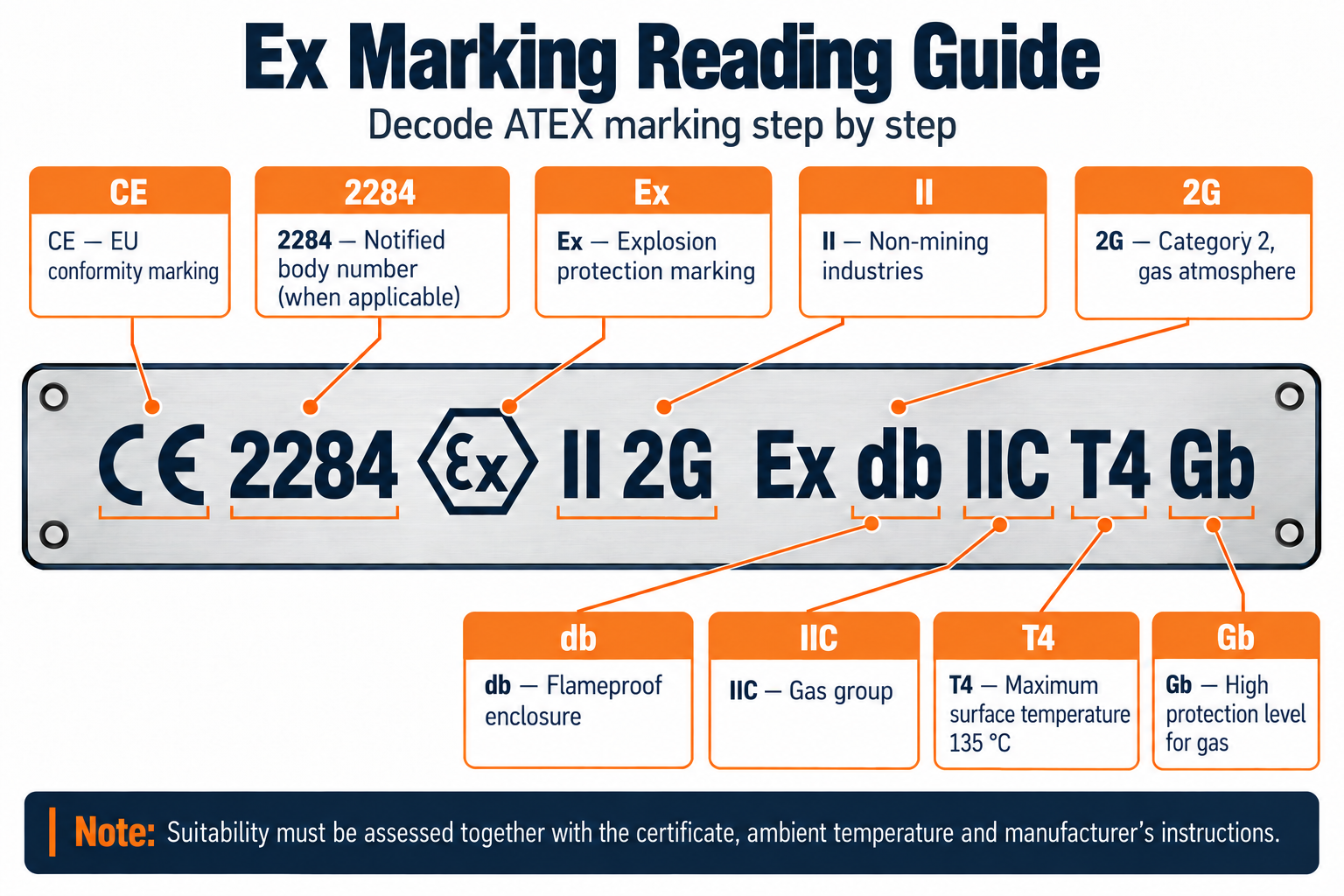
| Code | What it tells you |
|---|---|
| CE | The product has been placed on the market in line with the applicable EU requirements. |
| 2284 | The four-digit identification number of the notified body involved in production control. It appears next to CE when the applicable conformity-assessment route requires it. |
| Ex in the hexagon | The specific explosion-protection marking. |
| II | Equipment for industries other than mining. Group I is used for mines exposed to firedamp or combustible dust. |
| 2G | Category 2 equipment for gas, vapour or mist. Dust atmospheres use D instead of G. |
| Ex db | Flameproof enclosure. The enclosure contains an internal explosion and prevents flame transmission to the surrounding atmosphere. |
| IIC | The gas group. IIC is the most demanding group and includes gases such as hydrogen and acetylene. |
| T4 | A maximum surface temperature of 135 °C under the stated conditions. This is not the ambient-temperature rating. |
| Gb | High equipment protection level for gas atmospheres. |
The equipment category must match the site's hazardous-area classification. The usual relationship is:
| Atmosphere | Zone | Category | EPL |
|---|---|---|---|
| Gas | 0 | 1G | Ga |
| Gas | 1 | 2G | Gb |
| Gas | 2 | 3G | Gc |
| Dust | 20 | 1D | Da |
| Dust | 21 | 2D | Db |
| Dust | 22 | 3D | Dc |
In Zones 0 and 20 the explosive atmosphere is present continuously, for long periods or frequently. In Zones 1 and 21 it is likely to occur occasionally during normal operation. In Zones 2 and 22 it is not expected in normal operation and, if it does occur, lasts only briefly.
On an ATEX marking, the category appears as M1, M2, 1G, 2G, 3G, 1D, 2D or 3D. M categories apply to mines, G to gas atmospheres and D to dust atmospheres.
Designed to remain safe under the manufacturer's stated operating conditions and to continue operating in an explosive mine atmosphere. Independent protective measures maintain the required level if one means of protection fails.
Designed to remain safe during normal operation, severe operating conditions and changing environmental conditions. The equipment is intended to be de-energised when an explosive atmosphere is present.
| Marking | Basic approach |
|---|---|
| Ex d / db | Flameproof enclosure |
| Ex e / eb | Increased safety; reduces the risk of arcs, sparks and excessive temperatures |
| Ex i / ia / ib / ic | Intrinsic safety; limits electrical energy below ignition levels |
| Ex p | Pressurisation |
| Ex m | Encapsulation |
| Ex t | Protection by enclosure for dust atmospheres |
| Ex h | Control of mechanical ignition sources in non-electrical equipment |
Explore Ex Protection Types in Detail →
Combined protection example: Ex db eb IIC T4 Gb. This tells you that flameproof enclosure and increased-safety techniques are both used.
Here, 2D means Category 2 dust equipment, Ex tb protection by enclosure, IIIC conductive dust, T135 °C the maximum surface temperature and Db a high protection level for dust.
For dust applications, check the ignition temperature of both the dust cloud and any layer that may build up on the equipment. Thicker layers need a separate assessment.
This article is intended as a practical introduction. Equipment selection and conformity assessment should be carried out by competent persons using the current standards, product certificate and manufacturer instructions.